From Miura to LaFerrari: How the Supercar Learned to Grow Up
The first supercars were beautiful, fragile, and terrifying to drive. Modern hypercars are faster, safer, and more refined than ever. But have they lost something in the process?
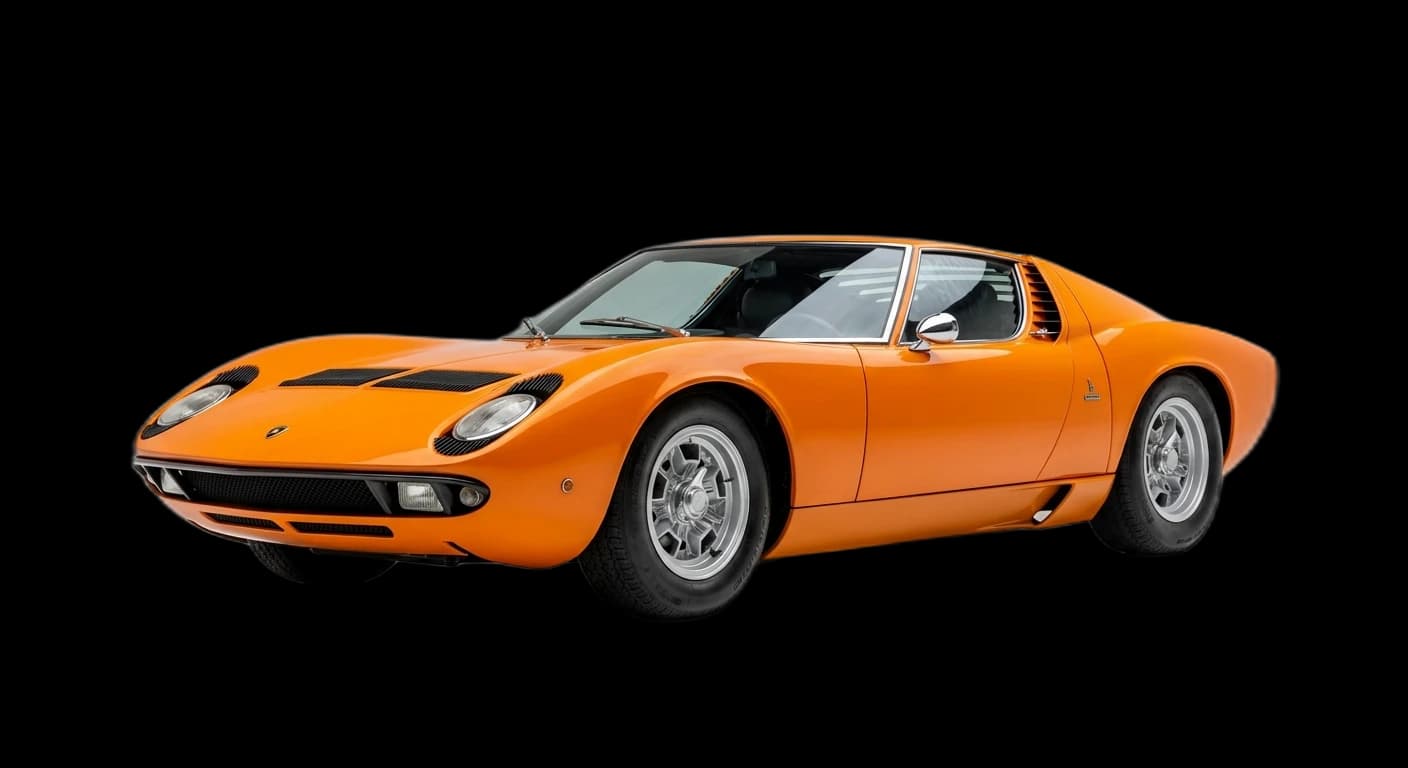
The Lamborghini Miura, unveiled at the
The Lamborghini Miura, unveiled at the 1966 Geneva Motor Show, was not the first fast car. It was not even the fastest car of its era. But it was the first car designed from the ground up to be spectacular. Its mid-mounted V12, its Bertone bodywork, its unapologetic commitment to drama over practicality: the Miura invented the supercar as a category.
## The Dangerous Years
Early supercars were genuinely dangerous. The Miura had a tendency to lift its front end at high speed. The Countach had visibility so poor that owners installed periscope mirrors. The Ferrari F40 had no ABS, no traction control, and a twin-turbocharged V8 that delivered its power with the subtlety of a grenade. The Porsche 959, the most sophisticated car of the 1980s, was the exception: it had all-wheel drive, electronically adjustable suspension, and tire pressure monitoring, all in 1986.
These were cars that demanded respect.
These were cars that demanded respect. Every drive was an event, and often an adventure. Breakdowns were expected. Ergonomics were an afterthought. The relationship between driver and machine was intense, unmediated, and sometimes adversarial.
## The McLaren F1: The Pivot Point
The 1992 McLaren F1 represents the moment the supercar grew up. Gordon Murray, a Formula 1 engineer, applied racing-level discipline to every aspect of the car. The F1 used a carbon fiber monocoque, gold foil heat shielding, a bespoke BMW V12, and a central driving position. It was the fastest car in the world, capable of 240 mph, but it was also refined enough to drive across Europe in comfort.
The F1 proved that ultimate performance
The F1 proved that ultimate performance and livability were not mutually exclusive. Its influence echoes through every hypercar that followed: the Enzo, the Carrera GT, the Veyron. Murray showed that a supercar did not have to be a compromise. It could be the best car in the world, period.
## The Hybrid Revolution
The arrival of the hybrid hypercar trinity in 2013, the Ferrari LaFerrari, the McLaren P1, and the Porsche 918 Spyder, marked another fundamental shift. For the first time, the fastest cars in the world used electric motors to supplement their combustion engines. The 918 Spyder could run in pure electric mode. The LaFerrari used its electric motor to fill the torque curve's gaps. The P1 used its motor for instant low-end response.
These cars were faster than their
These cars were faster than their predecessors in every measurable way. They were also safer, more controllable, and more environmentally conscious. The trade-off was complexity and weight. A LaFerrari weighs 1,585 kilograms, significantly more than the 1,100-kilogram F40.
## What Was Lost
The modern hypercar is an extraordinary machine. It is faster, more capable, and more refined than anything that came before. But something has been traded away. The rawness that made early supercars thrilling is now engineered out. A Ferrari F40 communicates every surface irregularity through the steering wheel. A LaFerrari filters the road through layers of electronic sophistication.
This is not a failure. It
This is not a failure. It is progress. A modern hypercar that behaved like a 1970s Countach would be unacceptable, possibly lethal, and certainly unsellable. The evolution from dangerous to sophisticated was inevitable and, on balance, positive.
But the old cars retain something that the new ones cannot replicate: the feeling that you are doing something genuinely extraordinary every time you turn the key. The Miura did not have launch control. It had courage.
Written by Singular Heritage Team
Published January 25, 2026 · 8 min read
Part of the Singular Heritage network