Inside the Countach: The Interior That Didn't Matter
Nobody bought a Lamborghini Countach for the interior. But the cabin tells a story about 1970s supercar engineering that the exterior never could.
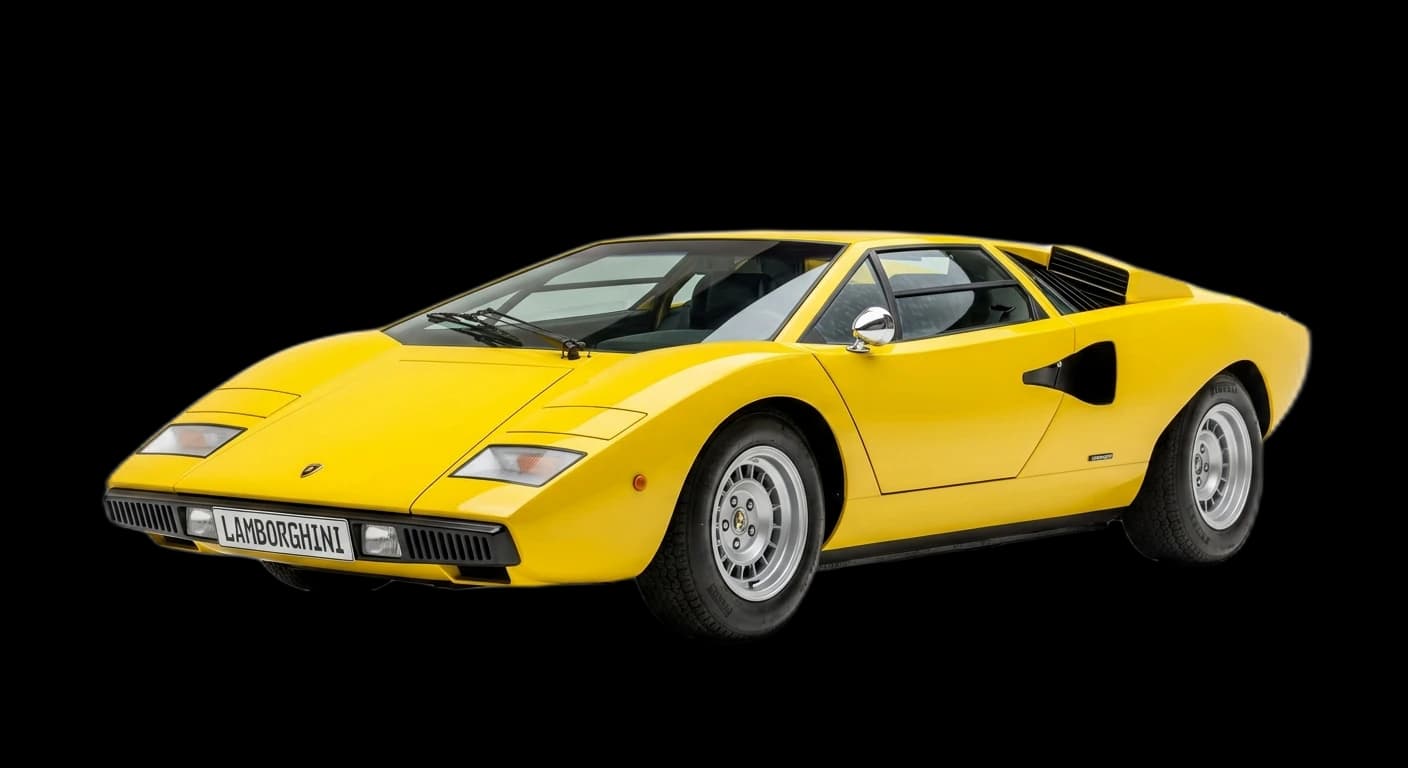
The Lamborghini Countach LP400 is the
The Lamborghini Countach LP400 is the most recognizable supercar silhouette ever drawn. Marcello Gandini's 1971 prototype for Bertone established every rule of supercar design that followed: low nose, dramatic windshield angle, visible engine behind the cabin, and proportions that made the car look fast standing still.
But sit inside a Countach, and you enter a different world entirely.
The driving position is absurd by any modern standard. The pedals are offset to the left because the transmission tunnel — housing the linkage for the gearbox mounted ahead of the engine — runs through the center of the car and pushes everything sideways. The steering wheel sits close to your chest. The seat doesn't adjust enough for anyone over six feet tall.
The rearward visibility is effectively z...
The rearward visibility is effectively zero. The V12 engine sits longitudinally behind your head, its intake trumpets visible through the rear window — assuming you can twist your neck far enough to see them. The side mirrors are small, badly positioned, and vibrate at speed until they show nothing but a blur. Reversing requires opening the door, sitting on the sill, and looking backward over your shoulder.
And none of this matters.
The Countach was never designed from the inside out. Gandini designed a shape — arguably the most important automotive shape of the twentieth century — and then Lamborghini's engineers fit a driving environment inside it. The cabin was the leftover space after the exterior, the V12, the transmission, the cooling system, and the structural members had taken their share.
The LP400's interior is the purest
The LP400's interior is the purest expression of this philosophy. The original 1974 production car has a cockpit that's almost spartan: thin leather seats, a simple instrument binnacle with five circular gauges, toggle switches for the electrics, and a gated manual shifter that moves with the precision of a rifle bolt. There's no radio in most LP400s. No air conditioning in early cars. No concessions to comfort whatsoever.
What the interior does have is theater. Turn the key, and the V12 fires with a mechanical cacophony that fills the cabin. The engine isn't behind a firewall — it's essentially in the same room as you, separated by a thin bulkhead. At idle, the twelve individual throttle bodies whistle and hiss. Under acceleration, the intake roar is physical — you feel it in your sternum before you hear it in your ears.
Fewer than 2,000 Countachs were built across all variants from 1974 to 1990. The LP400, with approximately 150 examples, is the rarest and most valuable — not because it's the fastest but because it's the most honest. No wing, no flares, no pretension. Just Gandini's shape and a V12 that happens to share your personal space.
The Countach proved something that every
The Countach proved something that every supercar since has struggled with: when the exterior is powerful enough, the interior becomes irrelevant. Nobody photographs a Countach dashboard. Nobody writes about its air vents. The shape is the entire story — and for once, that was enough.
Written by Singular Heritage Team
Published September 22, 2025 · 7 min read
Part of the Singular Heritage network