The V12 Question: Why BMW Put Twelve Cylinders in Everything
From the E32 7 Series to the 850CSi to the McLaren F1, BMW's V12 program was the most ambitious engine project in the company's history.
In 1987, BMW did something it
In 1987, BMW did something it hadn't done since the 1930s: it built a twelve-cylinder engine. The M70 was a 5.0-liter V12, and it would transform the company's ambitions over the next decade.
The M70 was essentially two BMW M20 inline-sixes joined at the crankshaft with a 60-degree V angle. Each bank had its own Bosch Motronic engine management system, its own throttle body, its own set of injectors. If one system failed, the engine could run on six cylinders — a safety feature that also illustrated the engine's fundamental architecture.
BMW launched the M70 in the E32 750iL in 1987, directly challenging Mercedes-Benz's 560 SEL — a car powered by a V8. The twelve-cylinder 7 Series was smoother, more refined, and symbolically more ambitious than anything Mercedes offered. It announced that BMW was no longer content to be the "driver's car" company. It wanted to be the best car company, full stop.
The real masterpiece came in 1989
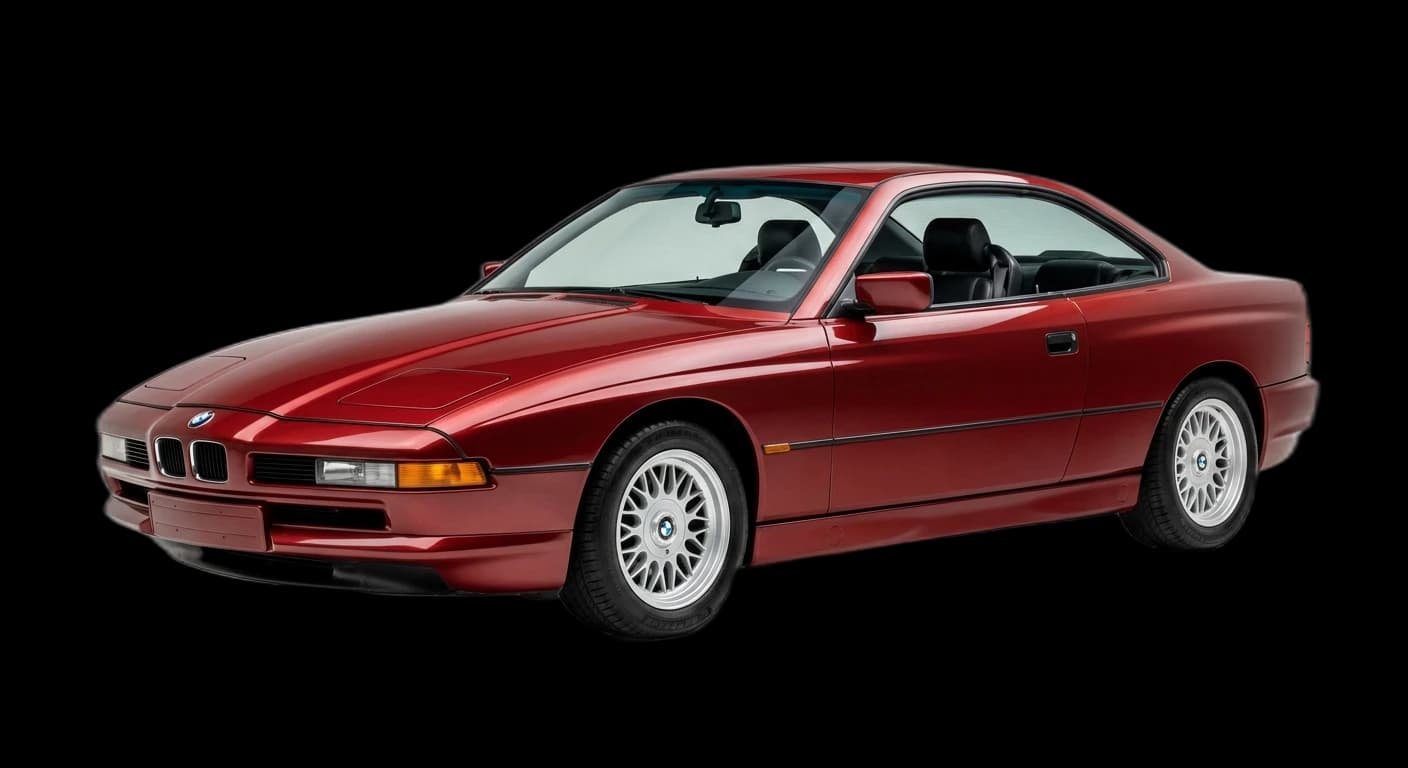
The real masterpiece came in 1989 with the E31 8 Series. The 850i used the M70 in its purest form: 300 hp, a six-speed manual gearbox, and a pillarless coupe body with a drag coefficient of just 0.29. The 8 Series was BMW's grand touring statement — a car that could cruise at 155 mph in near-perfect silence.
But BMW Motorsport wasn't satisfied with 300 hp. In 1992, they unveiled the 850CSi with the S70B56 — a fundamentally redesigned V12 with larger bore spacing, individual throttle bodies, and 380 hp. The S70 wasn't a modified M70; it was a new engine that happened to have twelve cylinders and a 60-degree V angle. Only 1,510 850CSis were built, making it one of the rarest modern BMWs.
The S70's most remarkable derivative never wore a BMW badge. Gordon Murray selected it as the basis for the McLaren F1's engine. BMW Motorsport's Paul Rosche enlarged it to 6.1 liters, added variable valve timing, and extracted 627 hp — making the F1 the fastest production car in the world. The S70/2, as it was designated, revved to 7,500 rpm and weighed just 266 kg. It remains the most celebrated V12 in automotive history.
BMW continued offering V12 engines in
BMW continued offering V12 engines in the 7 Series through four generations — E32, E38, E65, and F01. Each was smoother and more powerful than the last, but none captured the imagination like the original M70 and its motorsport derivatives.
The V12 question — why twelve cylinders when eight would do? — has a simple answer. Twelve cylinders aren't about power. They're about character. The perfect primary and secondary balance of a V12 means zero vibration at any speed. The power delivery is seamless, the sound is orchestral, and the sensation is unlike any other engine configuration.
BMW's V12 era may be ending — electrification is replacing cylinders with kilowatt-hours — but the S70's legacy endures. It proved that BMW could build the world's finest engine, and it gave Gordon Murray the heart for the greatest car ever made.
Written by Singular Heritage Team
Published December 3, 2025 · 9 min read
Part of the Singular Heritage network